LEGAL DOCUMENTS AND CLIENT CONFIDENTIALITY
Anonymize legal documents locally before AI review
Anonymise contracts and client correspondence on your own device, give the AI the anonymised copy, and restore the real names in the draft it sends back.
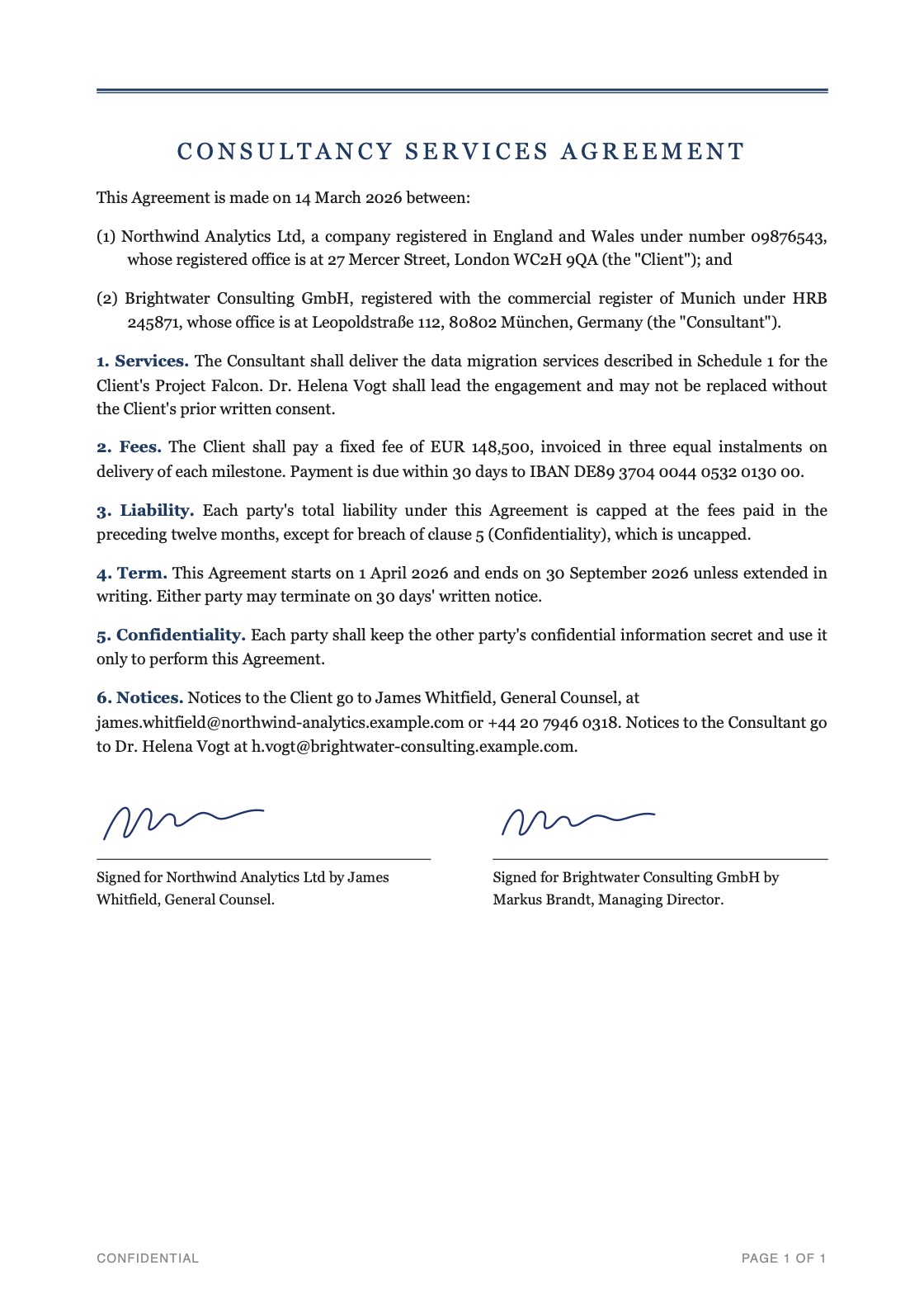
ANONYMISED TEXT
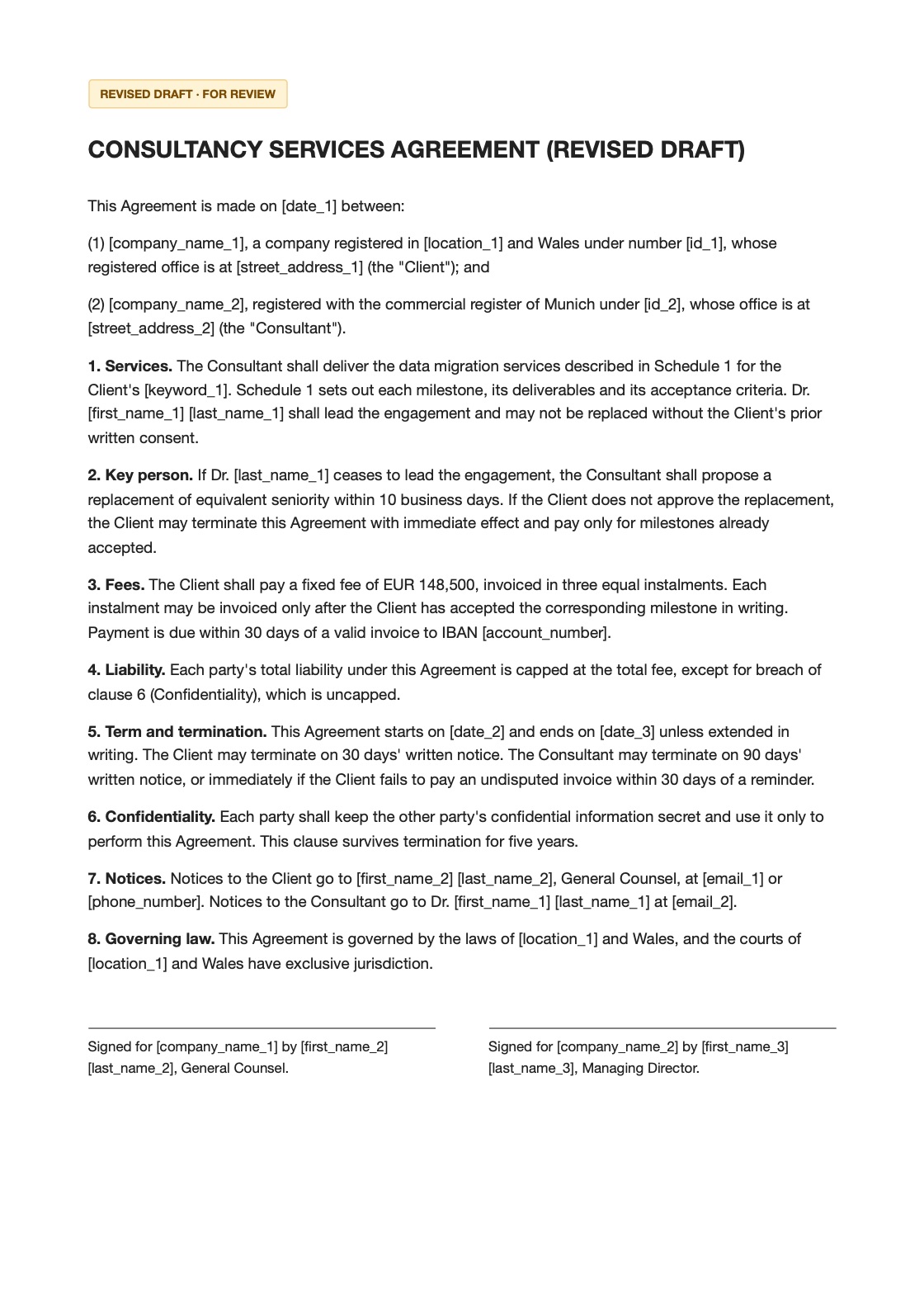
CONSULTANCY SERVICES AGREEMENT
This Agreement is made on [date_1] between:
(1) [company_name_1], a company registered in [location_1] and Wales under number [id_1], whose registered office is at [street_address_1] (the "Client"); and
(2) [company_name_2], registered with the commercial register of Munich under [id_2], whose office is at [street_address_2] (the "Consultant").
1. Services. The Consultant shall deliver the data migration services described in Schedule 1 for the
Client's [keyword_1]. Dr. [first_name_1] [last_name_1] shall lead the engagement and may not be replaced without the Client's prior written consent.
2. Fees. The Client shall pay a fixed fee of EUR 148,500, invoiced in three equal instalments on delivery of each milestone. Payment is due within 30 days to IBAN [account_number].
3. Liability. Each party's total liability under this Agreement is capped at the fees paid in the preceding twelve months, except for breach of clause 5 (Confidentiality), which is uncapped.
4. Term. This Agreement starts on [date_2] and ends on [date_3] unless extended in writing. Either party may terminate on 30 days' written notice.
5. Confidentiality. Each party shall keep the other party's confidential information secret and use it only to perform this Agreement.
6. Notices. Notices to the Client go to [first_name_2] [last_name_2], General Counsel, at [email_1] or [phone_number]. Notices to the Consultant go to Dr. [first_name_1] [last_name_1] at [email_2].
Signed for [company_name_1] by [first_name_2]
[last_name_2], General Counsel. Signed for [company_name_2] by
[first_name_3] [last_name_3], Managing Director.
CONFIDENTIAL PAGE 1 OF 1
SEE IT ON A REAL DOCUMENT
One contract, from original to restored answer.
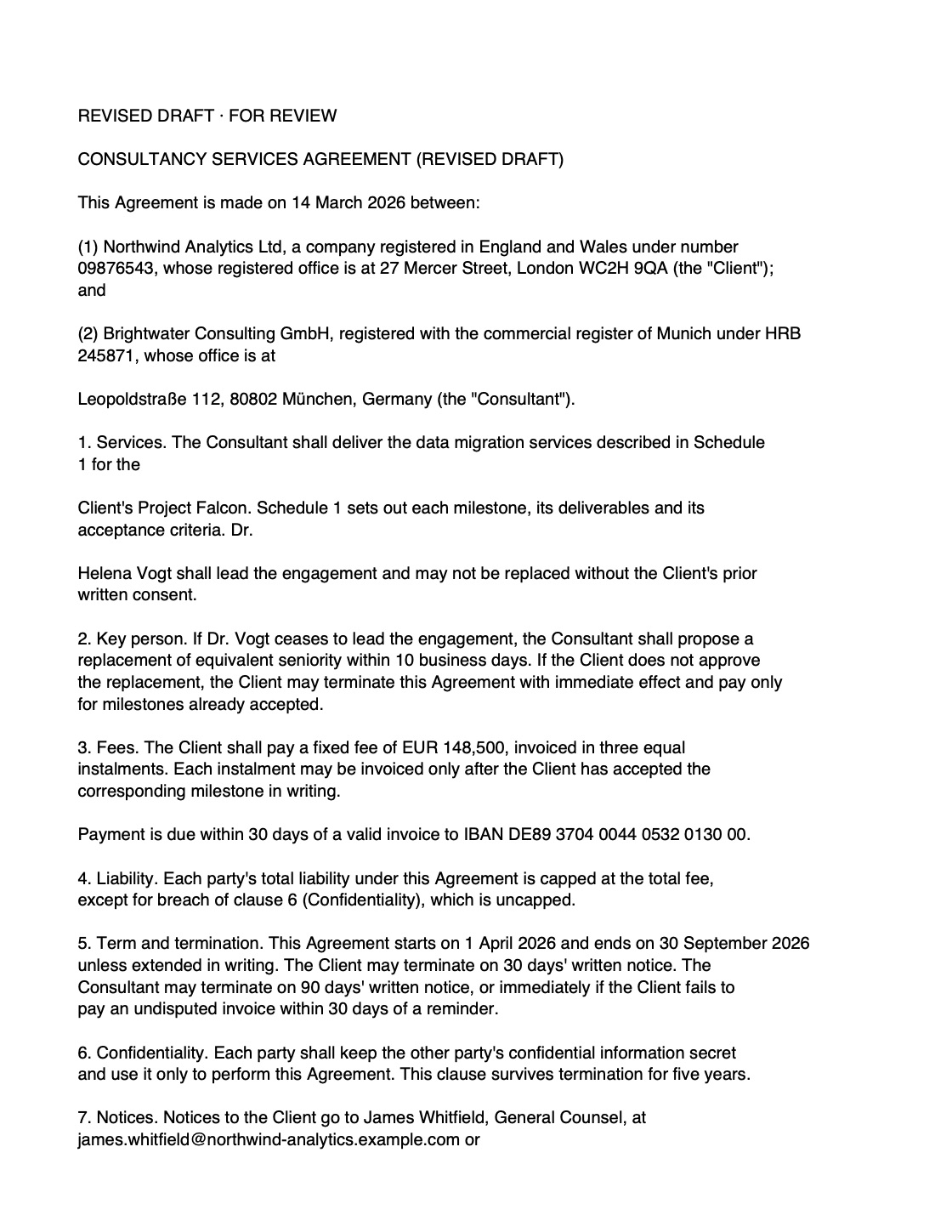
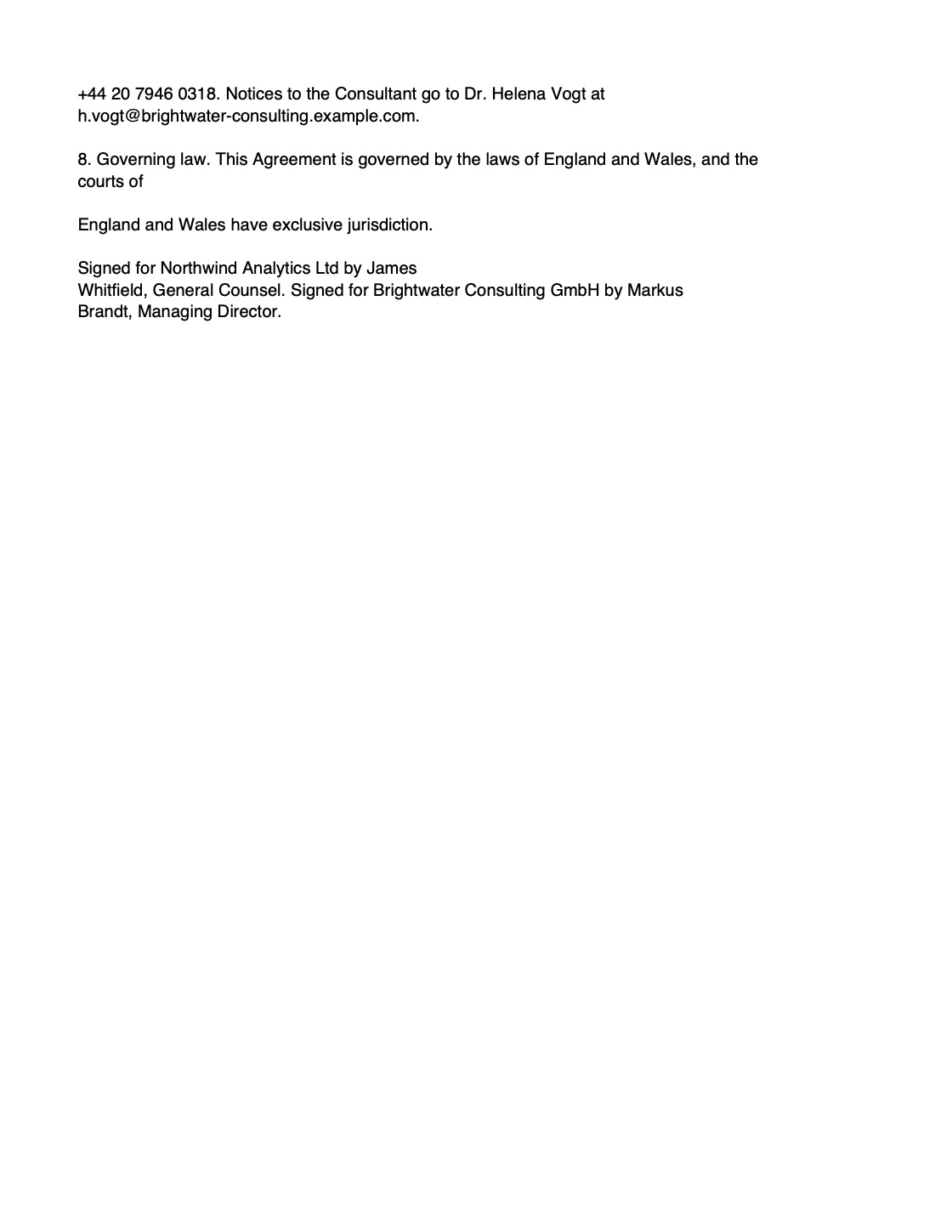
Give the AI the anonymised contract, get a revised contract back, and restore it on your device. The AI works with placeholders instead of names, addresses and identifiers.
![The anonymised agreement as DataAnonymiser writes it: plain text, with the companies, people, addresses, register numbers, IBAN, emails and phone number replaced by placeholders such as [company_name_1]. Opens the PDF.](/showcases/consultancy-agreement-anonymised-1.jpg)
YOUR PROMPT, WITH THE ANONYMISED PDF ATTACHED
Revise this agreement to protect the Client better. Return the complete revised agreement and keep every placeholder exactly as it is.
What gets redacted in a legal document
Detection runs on your device and replaces each value with a labelled placeholder. The same party keeps the same placeholder throughout, so the AI can still follow who owes what to whom.
- People and parties. Clients, counterparties, directors, signatories and witnesses.
- Contact details. Addresses, email addresses and phone numbers, including those in notices clauses and signature blocks.
- Account references. Bank account numbers and IBANs in payment terms.
- Dates. Signing, effective and termination dates.
- Your own terms. Matter references, deal codenames and trading names that generic detection can miss. Add them as custom terms or save them as presets, where your plan includes custom terms.

Who it's for
Lawyers and paralegals
Ask an AI to summarise, compare or redraft a clause without giving it client names, addresses or account numbers. Restore the real names in the draft it returns.
IT and security
Individual runs entirely on the device. Enterprise sends content only to a server your organisation installs and runs on its own infrastructure. Neither routes documents through DataAnonymiser-operated infrastructure.
Risk and compliance
Exports are new files rebuilt from the anonymised text, so author metadata, tracked changes and embedded objects stay behind. The placeholder mapping lasts only for the session.
Try it on a contract of your own
AI-based detection finds names, parties and account numbers on your own device, and puts them back in the draft the AI returns.
What the exported Word file, PDF or spreadsheet keeps
- New files, originals untouched. Exports are rebuilt from the anonymised text. Metadata, revision history, tracked changes, headers, footers, images, embedded objects, macros and links are not carried over. Comments are anonymised with the body.
- Not a visual redaction. A PDF comes back as a plain text PDF, a Word file keeps basic formatting and a spreadsheet keeps cell values only. Images are read with OCR, so check the wording against the source. For a redacted PDF to file or disclose, use your approved redaction process.
- File names can identify a client. They are kept unless you choose neutral names.
- Not a redline. Compare the AI's revision through your normal review tools. A changed exception, negation or defined term can alter a provision.
- Restore within the session. The mapping lives in the current session; reopening a file later does not recreate it. Check that each restored name sits in the right obligation.
- Pseudonymisation, not anonymity. Placeholders reduce the link to a person. They do not make a contract legally anonymous or settle questions of privilege [4].
- Approval stays with your firm. Whether a contract may go to an AI tool is for your firm's policy and professional rules to decide, not redaction. See the SRA's guidance on client confidentiality [1] and its AI warning notice [3], or ABA Formal Opinion 512 in the US [2].
Frequently asked
Questions about this workflow.
Can I anonymize a contract before using an AI tool?
Yes. DataAnonymiser replaces detected identifiers and your own custom terms on your device, and you review the rest. Whether the result may go to a particular AI service depends on the matter, your firm's policy and the applicable professional rules.
Does redaction preserve attorney-client or legal professional privilege?
DataAnonymiser makes no privilege determination or preservation guarantee. The responsible lawyer must assess the material, the proposed use and the applicable jurisdiction.
Can I redact company names and project codenames?
Yes, where your plan includes custom terms. Add the names, codenames and matter references you need hidden, including their variants. Replacing a codename does not conceal the strategy described around it, so read the surrounding paragraph too.
Are custom terms and presets saved anywhere?
Term presets are saved locally on your device; the placeholder mapping is not. A preset containing client names is another record to manage, so handle it the way the firm handles matter information.
Does our document content reach the vendor?
No. Individual runs on the device, and explicitly configured Enterprise clients use your organisation's own server. Sharing the output with an AI service remains your separate decision.
Related
Where else this comes up.
PSEUDONYMISATION
A local pseudonymisation tool to replace and restore identifiers
Replace identifiers with consistent placeholders and restore them locally during the working session. Review documents before sharing with AI or another reader.
ANONYMIZE DATA FOR CHATGPT
Anonymize data for ChatGPT with local PII redaction
Redact personal details before pasting into ChatGPT, then restore recognised placeholders in the response locally during the same session.
COMPARE
How this compares to the alternatives
Cloud redaction APIs, browser-only extensions and self-hosted libraries — what each one trades away.
REFERENCE
What is data anonymisation?
How anonymisation, pseudonymisation and masking differ in law, and which one actually takes data outside GDPR.
This guide describes document preparation, not legal advice. DataAnonymiser does not guarantee complete removal of confidential information, legal anonymity, preservation of privilege or the accuracy of AI-generated drafting. Apply the rules and review process governing your matter.